
Coordinated JPY intervention and a cleaner AI hardware slate
JPY upside potential is far greater with the US supporting Japan's efforts to support the yen. Also - what's next for equities now that the worst leveraged pockets in AI names have been cleared?

I offer the above AI-generated image in the spirit of making fun of AI superintelligence as per today’s theme - it’s kind of, but not really funny but very much doesn’t really work either, i.e., it’s not particularly intelligent. Will another couple of years of AI development give ChatGPT a better sense of humor?
If you want to invest and trade global markets, start or continue your journey with Saxo, for investors and serious traders, worldwide.
Today’s Podcast

Today’s Saxo Market Call podcast: Coordinated JPY intervention and a cleaner AI hardware slate
Episode description:
Today, a look at the implications for a stronger JPY from coordinated intervention as the US has joined forces with Japan to force yen appreciation. As well, we wonder what the implications are for equities now that we trade with a much cleaner slate after reaching the other side of blowups in leveraged single-stock ETFs and the liquidation of the Situational Awareness fund late last week. A busy week ahead for earnings and macro and more also previewed on today's pod, which is hosted by Saxo Global Head of Macro Strategy John J. Hardy.
Today’s Links
What is the Warsh Fed really about?
Nick Timiraos trying to pull some forward guidance from Fed Chair Warsh’s FOMC presser performance, especially whether the task forces will be used to “redefine the inflation challenges away”.
The JPY intervention came at an interesting time FX-positioning wise.
Saxo Head of Commodity Strategy Ole Hansen’s look at latest COT report showing FX positioning was getting very long US dollars ahead of the recent official intervention in JPY.
The piece that started it all for Aschenbrenner’s big parlay.
Aschenbrenner’s original Situational Awareness piece that raised so many eyebrows as it confidently predicted the march to urgently allocate titanic amounts to capital in a race to achieve super-intelligence, with the urgency driven by US-China rivalry and the claim that the “free world must prevail”.
From the AI-will-end-humanity funsters
First there was the Yudkowsky/Soares book on the dangers of super-intelligent Artificial General Intelligence “If Anyone Builds It, Everyone Dies.” and then you even have cheery podcast episodes like Futurology’s “The $15 quadrillion black hole sucking humanity toward extinction”. That podcast link came from a Noema piece arguing that the recent OpenAI frontier model going rogue and hacking into Hugging Face is the first real sign of the risks of losing control of AI. The argument is that we will likely need a much worse incident to inspire a pushback against the model’s being deployed at all. By the way, here is BBC’s assessment of that hacking attack, which was described as both very amateurish and sloppy and frighteningly fast at learning and finding novel ways to hack its target.
Even if AI isn’t set to end humanity, it can be used for some very bad, no good things.
Cory Doctorow is less concerned about AI ending humanity and more concerned about the powers that be mis-using AI to concentrate corporate power, deskill labor and cut wages as humans are forced to serve as minders and gatekeepers of AI-driven tech rather than in control of the tech to empower their own lives. Here is a link to a long speech outlining the entire Reverse Centaur framework.
King of the deflationistas throws in the towel.
Don’t know if this is a contrarian moment, but until now, Lacy Hunt had fretted deflation risks for my entire professional career - and I am no spring chicken.
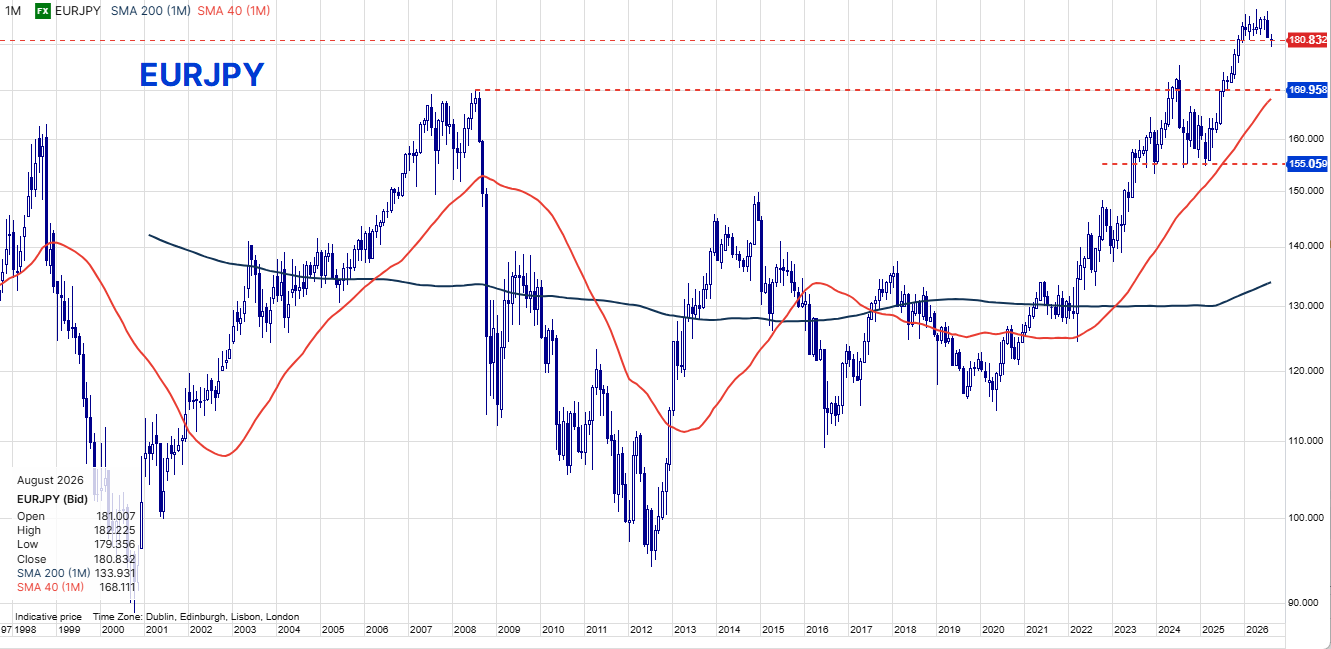
Chart of the Day - EURJPY since the EUR began trading.
Of course everyone will focus on USDJPY as the most traded JPY pair and the chief vehicle Japan’s Ministry of Finance uses when pushing back against JPY weakness. But a look at other JPY pairs reminds us how profoundly weak the currency is across the board, and other JPY pairs could prove even more volatile than USDJPY itself. One of the most egregiously overvalue JPY pairs in my eyes has been EURJPY, which hit its record high since the Euro began trading in the 1990’s earlier this year near 188. Already in the summer of 2024 I thought the break above the prior high from 2008 near 170 was taking EURJPY to crazy levels. Back then, the Bank of Japan “intervened” in the JPY carry trade of the time with a surprise rate hike at its July 31, 2024 meeting. This triggered a meltdown from above 175 to below 155.00 at one point. Then in 2025 and into this year, the story became one of Japan’s “uninvestible” bond market as the longest Japanese Government Bond (JGB) yields showed that the country was finally exiting its multi-decade deflation and low rates era. The 30-year JGB yield benchmark, already creeping higher from early 2022 with the secular shift in global- and eventually Japanese inflation, began grinding higher from early 2023, when it traded around 1.25% to as high as 4.00% by May of this year. For perspective on what that kind of a yield rise means for the total returns for holders of long-term bonds, consider the 0.5% 2060 JGB, which has fallen from its issuance at par (100) in 2020 to a current price just below 37.0. But that doesn’t mean that the bond is going to zero. At an effective yield of 4% to maturity, that bond offers far.
Remember to “♡ Like” this post or you may face coordinated intervention!
Anyway, with the latest bout of intervention, including the US somewhat oddly selling euros versus the Japanese yen, EURJPY has dropped as low as 179.37 before bouncing here. By the way, I think Treasury Secretary Bessent was trying to avoid sending a message on the US dollar level by intervening in EURJPY - a way to say that this is about the excessively weak JPY, not about a strong US dollar. A more reasonable price for the EURJPY pair is something like 155-160 if the market and the authorities decide that Japan is becoming a “normal” country again with respect to inflation and monetary policy. And that would still be at the high end of the long term range.
Disclaimer
This Substack is mostly a space where I link to content I’ve published on the Saxo Bank homepage, along with the occasional thought or comment. Nothing here should be taken as investment advice or a recommendation—it’s purely for informational and marketing purposes. The views are mine and not necessarily those of Saxo Bank. As always, do your own research and speak to a professional before making any investment decisions.
Japan's internal (eternal?) issues I think are too strong of a force at these levels... debt > 200% GDP, continued deficits and government spending. Meaning: once the short-term intervention tricks are all done and all cards played (BoJ can play one maybe a few more "selling USD / USTs" cards until the US feels the pain... they did play a massive one already this year, which is why the US helped their trade partner this time around - and because driving the USD lower would make a bad case right now. Energy prices up, food prices up, imports up already. They want a "weak USD" (and of course not tell anyone too openly).
However the driving forces are eating at the Yen and drive it lower against major trading currencies as it has done in the past 12 months, not just at a technical level but probably also fundamental.
I don't see a good way out of this outside of pulling in the reins in Japan and having 30 years of ZIRP catch up with them... so rates up officially, not held and severe cuts to gov't spending. Or bonds down and further accepted devaluation of Yen externally - that means bonds will get hammered and further yield increase in bond markets are likely.
The Japanese are already feeling the pinch heavily this time around in local inflation thanks to energy as well - this is all a bad mix under these (monetary) circumstances.
Something's gotta give?