
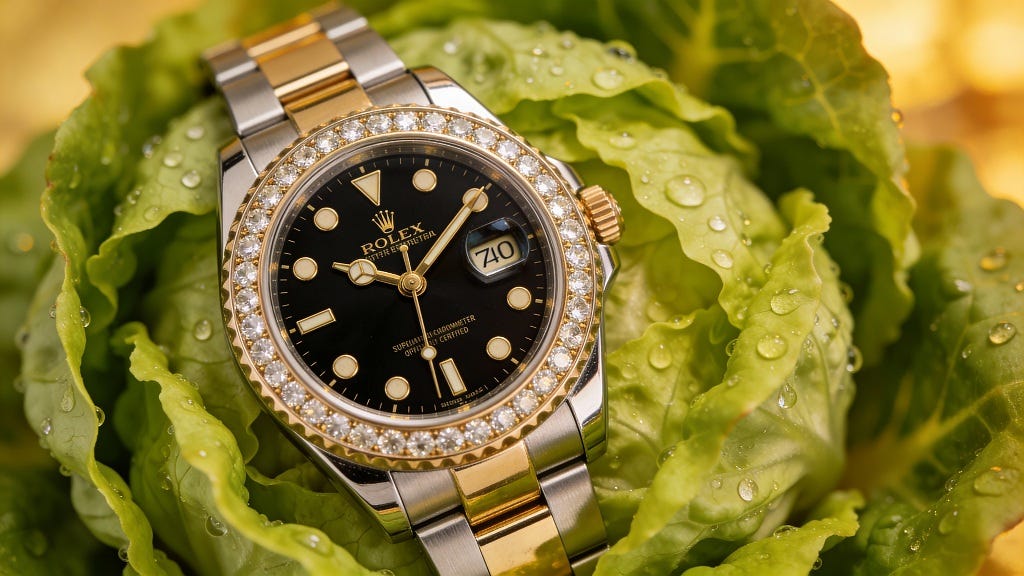
I love AI for the productivity boost it provides, but it still amazes me how even the state-of-the-art AI models can be pretty dumb and quite demonstrably so: it’s still really only a refined pattern matching service. A client I met at a Saxo event in Prague noted that AI image generators can’t put the correct time on the image of a watch, for example. So I decided to have a go at poking various AI engines for confirmation of this surprising claim. For the above image, for example, I prompted Nano Banana, Google’s latest and greatest AI image and video generator, to give me an image of “A jewel-encrusted Rolex watch on a bed of lettuce. The hands on the Rolex watch clearly indicate that the time is 7:40.” Why lettuce? No reason, just random. As you can see, the image showed the time as 10:10, probably as 99% of the source material that AI scrapers are finding of watch images show the time on the watch as 10:10 because it is the industry standard. (Likely due to the nice symmetry and the “smile-like” shape of the hands.). So the AI engine just matches the pattern, having no ability to match any logic it probably does have about how to tell time with what is in the image. If you could zoom in on the higher-res image of the above, you can also see that it can’t even accurately render the text - showing a very garbled “Perpetual Motion”.
Sure, a domain specific watch-image AI could probably be developed and sure, there are AI’s that specialize in showing text on images, but there is a distinct lack of intelligence here. Also note how the AI tries to use the date field to cram in a weird approximation of 7:40 that I requested in the prompt. After this experiment, I decide to see if I could “sweat” an LLM into throwing a bit more effort into the mix - so I headed over to ChatGPT and had the following little interaction. First the prompt with a bit of cheek/provocation:
“AI’s are pretty dumb when it comes to showing the time on the watch as requested by the human prompter. Are you also irretrievably dumb and not able to show me a Rolex watch with the time shown at 7:40 rather than the ubiquitous 10:10?”
ChatGPT answered: I can show you an image of a Rolex with the time exactly as you request — 7:40 — no problem at all. The issue you’re talking about (AIs defaulting to 10:10) is a long-standing quirk of image-generation models, because: 10:10 is heavily overrepresented in training images, watch hands at that angle leave brand text unobstructed, and many models “snap” toward familiar visual patterns. But I’m not constrained by that — I can generate the image precisely as requested.
I was impressed by ChatGPT’s confidence, and additional offers to show me specific Rolex models and in various photo-realistic styles. So I responded: You seem confident, then. Show me a Daytona with the time at 7:40 - place it on a serving of salade niçoise.
Here is what it came up with:
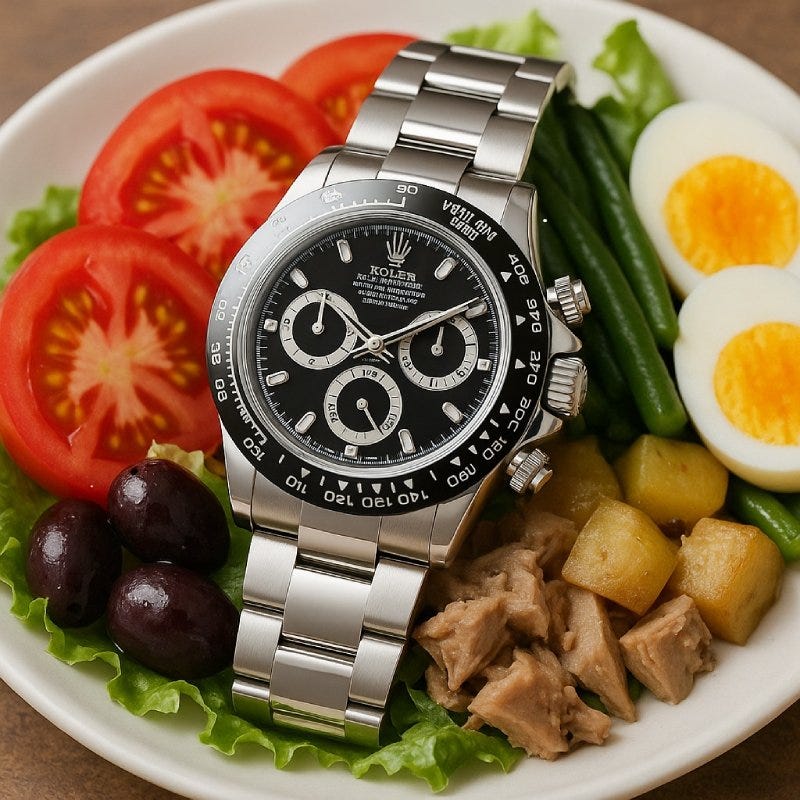
Nice - is that a “Koler” watch? And of course the questionable and incoherent numbering on the watch dial, the garbled text and the 10:10 time, etc…
Finally, just to test perhaps that it wasn’t the “conceptual” part of showing the time, but the fact that I was specifically asking for a photorealistic recreation, even specifically of a Rolex watch (where I am sure nearly all source material on the web is for watches set to 10:10) and maybe even distracting on top of that with the salad-inspired backgrounds, I decided to go simple and ask for a basic drawing instead. Hence my final prompt in this sorry episode: “Can you show me a child-like drawing of an analog watch, showing the time at 7:40?” Here is the unfortunate output that ChatGPT’s model provided:
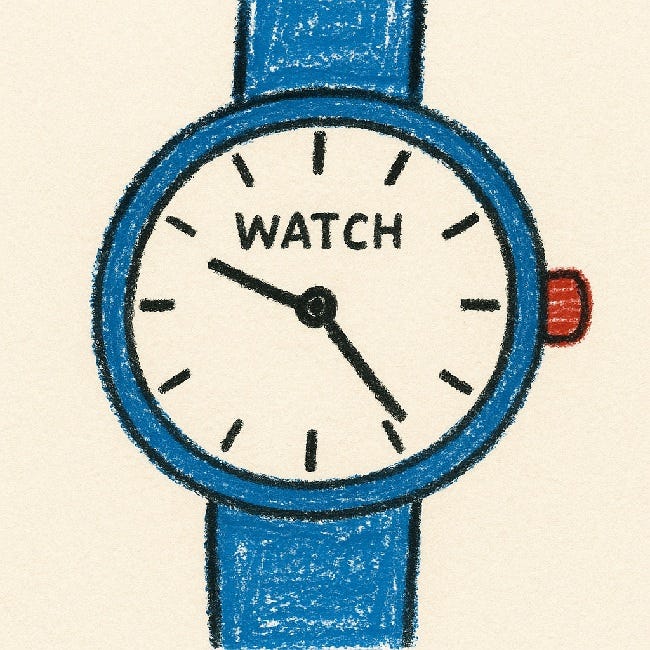
It’s not even 9:24 - the hour hand is misaligned. AI is getting smarter, but it certainly has a ways to go yet.
If you want to invest and trade global markets, start or continue your journey with Saxo, for investors and serious traders, worldwide.
Today’s Podcast

Today’s Saxo Market Call podcast: Is a volatility expansion on tap across markets post FOMC?
Episode description:
Markets are a bit nervous here ahead of the FOMC meeting tomorrow and the delayed key US data, with the key question afoot of whether the US treasury yields are set for a break higher, which could drive higher volatility across all other asset classes. Elsewhere, rising yields driving fresh woes for the JPY, with USD traders holding their breath trying to sort through the reaction function to different scenarios for US data. This and more on today’s pod, which is hosted by Saxo Global Head of Macro Strategy John J. Hardy.
Today’s Links
I penned the latest The FX Trader today, echoing the themes on interest rates discussed on today’s Saxo Market Call.
Where is the vision for how the center holds?
Part 3 of Mike Green’s important and viral series on the cost of living crisis for the middle class in the US and what drives inequality - the falling share for labor in the US economy, partly due to China, but also the US’ financialization trend. It’s extremely important reading.
Should randos record everything going on around them?
Loved this one on a “glasshole” perhaps getting his due (Meta Glasses wearer has his Glasses broken in half by a woman on the subway.)
TMSR’s for the win?
China is testing an important nuclear technology that, if successful, could deliver far more energy in the future than standard nuclear fission tech in the future: thorium molten salt reactors. The technology is incredibly promising in theory, but faces steep real-world challenges including the corrosion from salts and the radioactivity of the reactor parts. But China is achieving new milestones recently, and there is even at least one Danish startup in the space - Copenhagen Atomics. The link has a fairly active news site and blog posts by CEO Thomas Jam Pedersen, who the Saxo Market Call interviewed way back in 2021 and Macro Voices spoke with over three episodes at the start of this year. Here is Part 1.
Don’t count Europe out just yet…
From my network of friends came a link to an intriguing poster on X on all things take-over related, discussing Europe’s under-recognized potential as sentiment could be far too pessimistic on the continent’s outlook and the opportunities there, with the outfit suggesting that Europe has “26 million SME’s, many with aging owners.”.
AI to supplant human labor in 3, 2, 1….
If you want to read something disturbing, on the risks that AI will render humanity unnecessary - at least for the intellectual labor we can offer - here’s one for you. Very much in the opposite direction of my poking fun at dumb AI in the commentary at the top of today’s post.
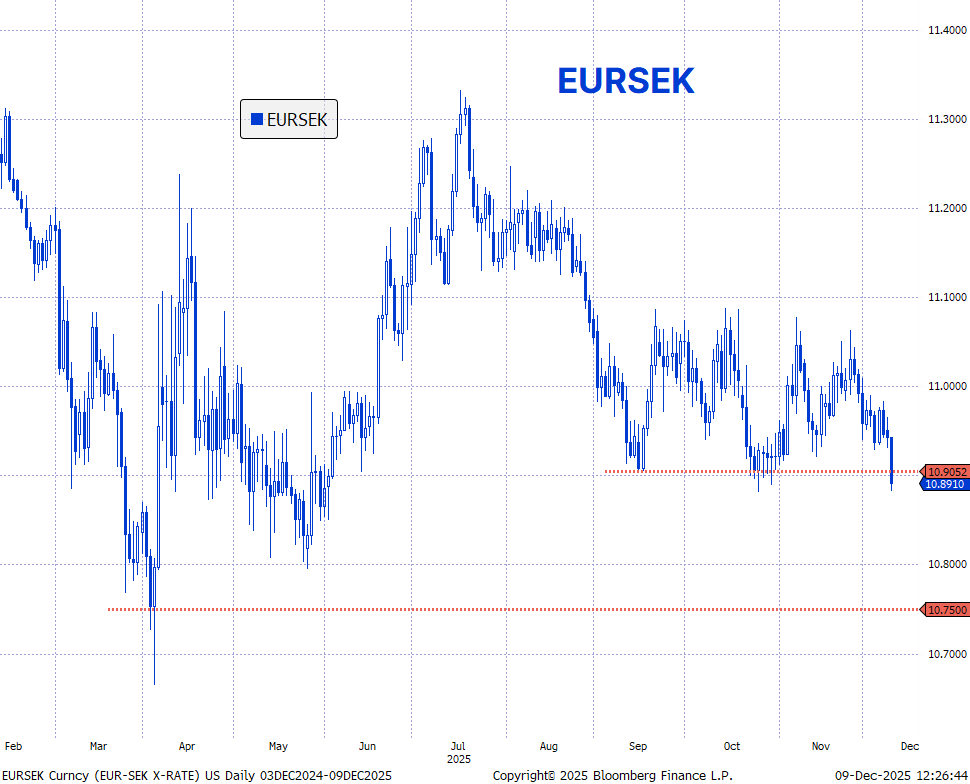
Chart of the Day - EURSEK
One that I have been waiting for to break lower, supported by end-of-year seasonality (SEK hedging) and as Sweden maintains a pristine national balance sheet relative to most Eurozone countries (would you believe under 35% of GDP) amidst the thematic focus on debt sustainability globally. A 10.89 break here could lead to 10.75 and maybe even 10.50 eventually.
Disclaimer
This Substack is mostly a space where I link to content I’ve published on the Saxo Bank homepage, along with the occasional thought or comment. Nothing here should be taken as investment advice or a recommendation—it’s purely for informational and marketing purposes. The views are mine and not necessarily those of Saxo Bank. As always, do your own research and speak to a professional before making any investment decisions.
Fascinating breakdown of the pattern-matching problem. The 10:10 watch thing is kinda the perfect example of how these models are basically just sophisticated autocomplete rather than reasoning engines. What i find interessting is this mirrors whats happening in markets too, where algos trade patterns withot understanding the underlying fundamentals, leading to reflexive dynamics that can blow up spectacularly when the pattern breaks.
Because even the badly written prompt contains the information that the object is a watch. And the AI engine can pair this information with the digital representation of the watches on millions of images used for training. Brute computing force, not intelligence. Training to recognise the correct time shouldn’t take too long if we have the correct and sufficiently representative samples to do that.